Entity Resolution for SNAP Investigations
A Blueprint for Turning Fragmented Program Data into Actionable Intelligence
SNAP investigations succeed or fail on identity clarity across messy records, changing household composition, and cross-system duplication. Entity resolution delivers identity clarity that strengthens investigative speed, accuracy, and defensibility by producing consistent identities and relationships that downstream workflows can rely on.
This implementation blueprint covers:
- Four SNAP scenarios where entity resolution pays off fast, and the identity and relationship challenges each depend upon.
- A five-step implementation blueprint, with outcome metrics to track adoption, throughput, defensibility, and payment accuracy.

How Entity Resolution Supports SNAP Investigations
SNAP investigations sit under program integrity. Common investigations include recipient-side intentional program violations, retailer trafficking, and coordinated schemes that connect multiple households, stores, and time periods. State agencies typically lead recipient-side eligibility and misuse cases, while the USDA Food and Nutrition Service (FNS) provides oversight and runs retailer compliance actions.
Across SNAP workflows, identities and relationships fragment across applications, case records, EBT activity, unemployment insurance records, Social Security benefit records, and other authorized external data. This makes patterns harder to interpret and defend.
Entity resolution aligns eligibility facts, transactions, case notes, and third-party indicators to provide the connected entity data needed for coherent case narratives. It provides a 360-degree view of program participants and merchants/vendors, supporting investigators and due process by reducing partial-identity decisions and preventable false escalations.
SNAP Investigations Are an Identity Problem
Consistent identity resolution across sources is a persistent operational bottleneck. Investigators see fragments of the truth across systems because data is siloed, incomplete, and inconsistent.
Where Program Integrity Breaks Down
- Duplicate and conflicting identities: People and households appear under multiple names, identifiers, and time slices across systems and jurisdictions.
- Household and location volatility: Composition changes, address churn, and inconsistent identifiers make it hard to anchor eligibility context over time.
- Siloed signals and deliberate obfuscation: Cross-program indicators, aliases, identity reuse, and the misuse of deceased identities often remain undetected without a resolution layer.
- Retailer and store ambiguity: Store identities fragment across names, addresses, and ownership records, making it easy to misread transaction patterns and difficult to recognize duplicate, misidentified, or fake merchants.
Why the Stakes Keep Rising
SNAP relies heavily on federal and state data matching for eligibility verification and integrity checks, and USDA oversight and quality control reviews are raising expectations for measurable improvements in accuracy, controls, and documentation. Program integrity teams have a strong incentive to mature data technology, data quality, and investigative workflows so they can stand up to oversight.
As oversight tightens, states are gaining access to richer external signals. Retailer disqualification letters and supporting data are already shared with states, and the trend is toward more standardized data-sharing processes over time. The limiting factor becomes whether this data can be tied to the right people, households, and retailers.
Oversight pressure shows up in both investigations and payment accuracy performance.
Payment Accuracy is a Program Integrity Driver
USDA oversight is also pushing states to reduce improper payments measured through the SNAP Quality Control process. These error rates reflect payment accuracy, not fraud determinations, and they may include both household and agency-driven mistakes. Payment errors can be overpayments or underpayments, including cases where an eligible household receives the wrong benefit amount or an ineligible household receives benefits. (For FY2024, the published PER table reports both overpayment and underpayment components alongside the total rate, which reinforces that accuracy spans multiple failure modes.)
For state leaders, this turns identity quality into operational and oversight risk. FNS policy also ties performance improvement expectations to error rates, and FNS can require corrective action planning for states with elevated error rates under program guidance. Entity resolution supports this agenda by anchoring a consistent identity and household view over time across wage signals, household changes, address churn, and cross-system duplicates, so eligibility context can be calculated and reviewed against the right entities.
Four Scenarios Where Entity Resolution Pays Off Fast
Entity resolution determines when records refer to the same person, household member, or organization, even when identifiers are incomplete, inconsistent, obfuscated, or change over time. It also determines when records that appear similar actually refer to different entities, and identifies relationships between entities, including households, stores, and associated networks.
These four investigative scenarios show where a resolved, explainable entity view immediately improves triage and case assembly. Each one depends on accurately linking people, households, retailers, and events across siloed systems without creating false matches.
The goal is faster, more confident prioritization and stronger case assembly with fewer preventable false escalations. The same identity clarity also improves routine benefit accuracy work by aligning eligibility context to the right eligible household.
1. Duplicate Participation and Cross-Jurisdiction Identity Conflicts
Interstate duplicate participation prevention is a formal requirement via the SNAP National Accuracy Clearinghouse (NAC), with submissions from participating states on each working day.
Entity resolution value: Easily resolve non-standardized data across states, helping to reduce false positives and negatives, reconcile name and identity variations, and connect household members to avoid partial identity decisions.
2. Eligibility Misrepresentation and “Fragmented Truth” Cases
Income, employment, incarceration, deceased indicators, and address history often sit across siloed systems in inconsistent formats. Misrepresentation and intentional obfuscation remain hidden when each system is analyzed in isolation.
Entity resolution value: Link claimant identities across many varied internal and third-party data sources, and over time, so the case file reflects a coherent entity timeline instead of disconnected facts.
3. Trafficking and Organized Abuse Patterns That Hide in Networks
Investigations often rely on network detection: who is related to whom across recipients, households, and merchants. When identities and relationships are unresolved, networks fragment into duplicates that appear unrelated, and unrelated entities can be mistakenly merged into false clusters that appear coordinated.
Entity resolution value: Produce entity-resolved data that downstream link analysis, scoring, and case triage workflows can use with higher confidence.
4. Retailer-Facing Signals That Trigger Recipient-Facing Work
FNS guidance says states can use retailer disqualification data to identify client households with suspicious transaction patterns for investigation. This data alone may not be enough to disqualify a client, but it helps focus investigative time and effort to find additional evidence.
Entity resolution value: Connect recipient identities and households across events so states avoid escalation based on a single signal type, such as high transaction frequency at a disqualified retailer.
Implementation Blueprint for Program Integrity Teams
The scenarios above show where entity resolution creates fast lift. The next step is implementation. This five-step blueprint lays out an operating model that teams can pilot quickly, scale safely, and defend under oversight.
1. Define the Entity View
Resolve identities and relationships from multiple, disparate systems into consistent, explainable entities that downstream tools can trust. Establish rules and review paths for common SNAP realities such as address changes, household composition changes, and inconsistent identifiers.
2. Connect the Evidence
Fuse entity-resolved identities and relationships with other authorized signals, including third-party and interagency data, to support link analysis, clustering, and case story assembly. The goal is higher context density per case, with fewer gaps caused by duplicate or fragmented identities.
3. Operationalize Triage
Feed clean, resolved entities into risk scoring systems and queues so analyst time goes to the highest-value work first. Treat scoring and triage as downstream consumers of the entity view, because scoring quality is constrained by identity quality.
4. Keep It Current
Refresh the entity view on the cadence the mission requires, including NAC and transaction-driven updates, while keeping final decisions human-reviewed. Entity resolution outputs should flow into existing triage and case workflows, with automation for high-confidence outputs and review gates for ambiguous cases.
5. Prove the Outcome
Log provenance, match rationale, and review actions so decisions remain auditable and defensible. Explainable entity resolution enables operational capabilities that support oversight, appeals, and cross-team coordination.
Suggested Outcome Metrics
- Adoption: analysts and workflows using the entity view (active users, cases touched).
- Throughput: time to case assembly and cases per analyst (median hours, weekly volume).
- Defensibility: provenance and match-rationale coverage in escalations (percent with full rationale).
- Payment accuracy: targeted error reduction (overpayment and underpayment rate movement for the targeted workflow).
With the operating model defined, agencies can evaluate how to implement the entity resolution layer in their environment and procurement pathways.
Senzing and Carahsoft for Public-Sector SNAP Workloads
What Senzing Contributes
The Senzing entity resolution SDK plugs into investigative, analytics, and case workflow applications to provide an explainable, real-time view of who is who and who is related to whom. It resolves messy, conflicting data into consistent entities and relationships that operational workflows can rely on. Senzing preserves the rationale behind resolution decisions so teams can trust the output and defend downstream actions when cases are reviewed, audited, or appealed.
 Enhanced Identity Verification

By cross-referencing attributes like name, SSN, DOB and address, identity verification is improved.
Advanced Data Integration

Senzing allows organizations to ingest data from internal and external data sources quickly and easily.
Improved Behavioral Analysis

With 360-degree views and hidden connections revealed, downstream behavioral analysis improves.
Identity and Relationship Context for SNAP Workflows
Senzing aligns well with SNAP program integrity, where identities fragment across time, systems, and jurisdictions, and where household and retailer relationships often shape investigations. As new records arrive, Senzing updates entity views and revises earlier resolution outcomes when additional information changes the picture. This helps teams keep case narratives aligned to the latest available evidence.
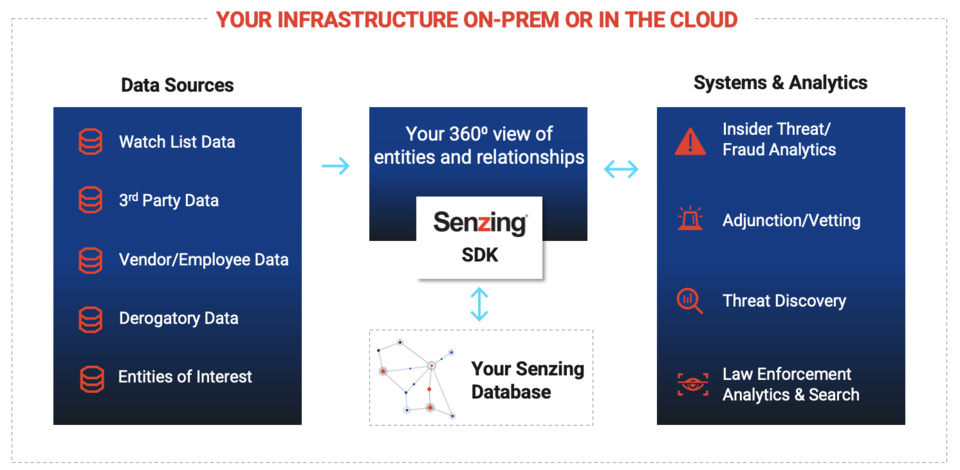
Senzing is deployable in agency-controlled environments, with code shipped to the customer. All data stays in the agency environment, whether on-prem or in the cloud. No data flows to Senzing, Inc.
How Carahsoft Helps Agencies Buy and Deploy
Carahsoft is a Master Government Aggregator® and distributor supporting public-sector procurement. Carahsoft provides streamlined paths to acquire Senzing through common public-sector contract vehicles, including agency-specific and government-wide federal, state and local contracts. Carahsoft’s wide variety of schedules, contracts and purchasing agreements make procuring the solutions you need fast and easy.
Core Senzing Capabilities That Support Investigations
- Principle-Based Entity Resolution: Attribute behaviors, such as frequency, exclusivity, and stability, are used to resolve entities without requiring pre-training or tuning.
- Entity Centric Learning™ technology: Builds an “entity resume” over time, which can improve resolution when identities evolve or are deliberately obfuscated through aliases, phones, emails, and other attributes.
- Relationship awareness: Brings together disclosed relationships and discovered relationships derived from shared attributes. This supports household-centric and network-centric investigations.
- Explainability: Shows why records were linked or kept separate, and how an entity evolved as new information arrived.
Verisk Case Study
Challenge
Verisk, a global leader in risk assessment and data analytics for the insurance industry, faced challenges with multiple entity resolution systems across its organization. These disparate systems led to inefficiencies and increased costs.
Solution
Verisk implemented Senzing entity resolution technology to standardize data governance and increase efficiency across the enterprise.
“The approach Senzing takes, including the ability to discover connections between entities and build a relationship graph, is far ahead of any entity resolution solution we’ve seen.” – Gurshish Dang, Head of Enterprise Data Management at Verisk
Outcomes
- Enterprise scale: Loaded ~420 million unique identities and linked more than 1.6 billion records into a centralized service.
- Higher matching quality: Reported a sharp decrease in false positives.
- Fast, efficient implementation: Initial cloud-based deployment on AWS was handled by five team members, without rule-writing or training and tuning.
- Performance at scale: Achieved sub-second response times for almost all searches, with complex searches taking only a few seconds.
Optional Additional Aptitude Case Study
Challenge
Aptitude Global needed better data matching and relationship detection for the Aptitude Intelligence Platform. Fragmented identities and duplicate nodes obscured true connections in network graphs, reducing analytic accuracy and slowing investigations and compliance workflows.
Solution
Aptitude embedded Senzing entity resolution into the Aptitude Intelligence Platform. The goal was to resolve messy, conflicting records into accurate entities, surface non-obvious relationships, and provide explainable match rationale that users can trust.
Outcomes
- Clearer network graphs: Linked multiple records and nodes that represent the same real-world entity, producing cleaner graphs and more reliable relationship analysis.
- Explainability for confident decisions: Provided “why” and “why not” data for matches and non-matches, supporting analyst trust and audit-ready workflows.
- Stronger detection of hidden networks: Improved the platform’s ability to identify suspicious connections and patterns in real time, including complex cases like money mule networks with multiple identities across institutions.
Transaction Signals Need Identity Context
- Signals travel with the entity: Patterns aggregate to the right household or retailer, reducing noise and preventing phantom clusters caused by duplicates.
- Context separates routine from risk: The same behavior can look suspicious or normal depending on household composition, address history, and retailer attributes that sit in different systems.
- Explainability matters as much as detection: When a signal triggers review, teams can show what records were linked and why, plus which supporting facts shaped the escalation decision.