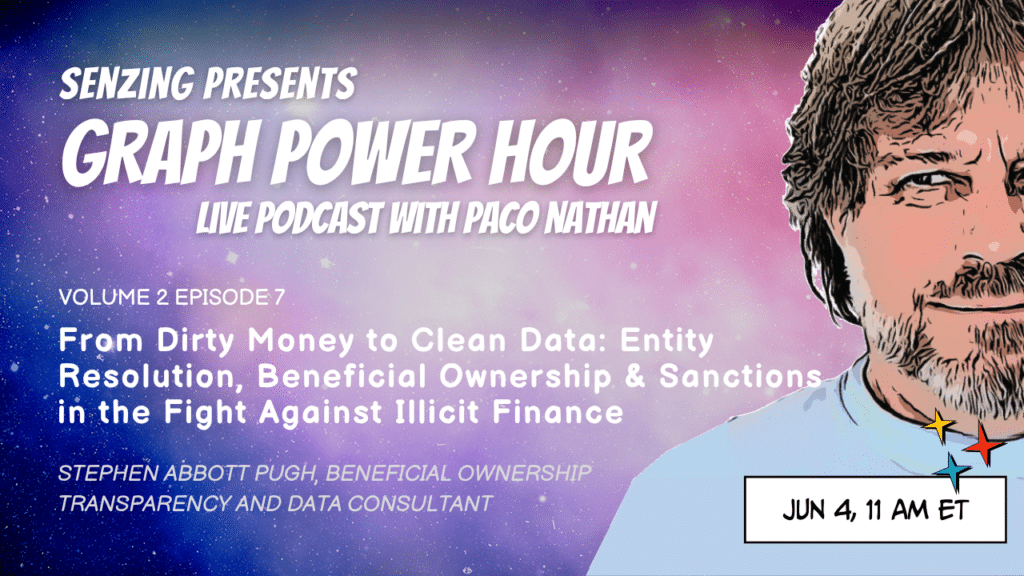
Graph Power Hour V2 Ep 7
From Dirty Money to Clean Data:
Entity Resolution, Beneficial Ownership & Sanctions in the Fight Against Illicit Finance
Webinar Series with Paco Nathan of Senzing & Guest Stephen Abbott Pugh of Understand Beneficial Ownership

Beneficial ownership transparency is having a moment. Governments are demanding cleaner data, regulators are tightening sanctions screening, and investigators are under pressure to connect the dots across corporate structures that span dozens of jurisdictions and use different names, different formats, and different rules for the same underlying facts.
In this episode, host Paco Nathan sits down with Stephen Abbott Pugh, a beneficial ownership transparency and data consultant based in Brussels. Stephen spent four years leading the team that built the Beneficial Ownership Data Standard (BODS), the open standard now referenced by the OECD, the World Bank, and UNODC, and used by national registers from Armenia to Botswana. Together they map the fast-moving regulatory landscape (the EU’s AML package, FATF’s tightened recommendations, the US Corporate Transparency Act’s rollback, and the UN’s parallel tax and development tracks) and keep coming back to one unglamorous, foundational problem: matching the same person or company across data sets that don’t agree on a name, an address, or an identifier.
The conversation was recorded ahead of the UK’s Illicit Finance Summit, rescheduled to December 2026, which Stephen expects to be a real test of whether governments will make beneficial ownership data more open, more verified, and more usable worldwide. Read on for the full breakdown, or jump to the links list below for the tools and standards discussed on the call.
Why Beneficial Ownership Data Matters
Beneficial ownership data identifies the real people who own or control companies and trusts, cutting through layers of corporate structure to answer a simple question: who is actually behind this entity? Registers that collect this information have only existed in most countries for a little over a decade, but the case for them keeps getting stronger. Stephen pointed to several concrete uses:
- Improving trust in business relationships, since people can see who they are actually dealing with
- Tracing how one company relates to or is owned by another, including across borders
- Fighting illicit financial flows and financial crime, particularly cases that rely on shell companies to hide activity
- Supporting effective taxation, including wealth taxes, where authorities need to know what individuals actually own and control
- Detecting procurement fraud, including the surge of cases uncovered during COVID-era public spending
- Focusing national investment and resource planning
- Enforcing sanctions, since ownership and control determine which entities are caught by a sanctions designation
- Tracing high-value assets such as real estate and yachts back to the people who actually own them
A Regulatory Landscape Moving on Every Front
Roughly ten years on from the Panama Papers, Stephen described a landscape where “lots of regulations are changing” and “there’s also an expectation that data will be shared with more and more people to be useful.” Four bodies are driving most of it.
The European Union’s AML Package
The EU passed its AML package in 2024, creating a new anti-money laundering authority based in Frankfurt and a single rulebook for the whole of Europe covering how beneficial ownership data is collected, how customer due diligence is done, and how issues get reported. Two dates matter most: the EU’s timeline called for broader access to European beneficial ownership registers from July 2026, and for the full rulebook to be in force across companies and trusts EU-wide by July 2027. At the same time, the EU is also pursuing initiatives like EU Inc, aimed at making it easier to set up a company that operates across member states, which raises its own questions about how ownership data gets shared once a company can register in one country and operate in all of them.
FATF Tightens the Rules, and the Grading
The Financial Action Task Force (FATF), the world’s leading standard-setting body on anti-money laundering, started with banking-focused rules roughly three decades ago and has since expanded into anti-money laundering and counter-terrorism financing. Its Recommendation 24 (beneficial ownership of companies) and Recommendation 25 (beneficial ownership of trusts) were both updated in 2023 and 2024, with new guidance to match. The bigger shift is in how FATF grades countries: it now looks not just at whether the rules are on the books, but whether countries are effectively using the beneficial ownership information they collect. Giles Thomson, HM Treasury’s Director for Economic Crime and Sanctions and previously FATF’s vice president, took over as FATF president in July 2026 for a two-year term, with a stated focus on information sharing and cross-border collaboration. The US itself is up for FATF assessment in October 2026, a review with real implications for how seriously the US beneficial ownership regime is taken internationally.
The US Corporate Transparency Act, Rolled Back
The US Corporate Transparency Act originally set out to build a beneficial ownership register covering all US companies. Enforcement changed quickly after the 2024 election, and domestic US companies no longer have to report. Reporting now falls mainly on foreign-created entities registered to do business in the US, which Stephen put at roughly 1 percent of all US companies. That leaves the large majority of US companies outside beneficial ownership reporting entirely, a gap Stephen called “a huge issue.”
The UN’s Parallel Tracks
Separately from AML policy, the UN is running two processes worth watching. The UN Tax Convention aims to shift global tax rule-setting away from OECD-led processes toward a UN-wide framework, with a final agreement targeted for 2027; the debate touches illicit financial flows, wealth taxes, and who gets a seat at the table. The Financing for Development Conference (FFD4) separately produced commitments to strengthen beneficial ownership registers, interconnect them across borders, and work toward a global beneficial ownership registry, a direction Stephen described as agreed in principle but still far from funded or built.
Access Is Still the Biggest Bottleneck
Even where beneficial ownership registers exist, getting into them is its own challenge. The EU’s legal framework has swung on this question twice already: the 4th Anti-Money Laundering Directive first opened registers to civil society and investigators roughly a decade ago; the 5th Directive then made registers fully public; a 2022 court ruling found that step too far and pulled back toward more restricted access, while still preserving access for anyone with a “legitimate interest.” The EU now recognizes roughly a dozen legitimate interest categories, including journalists, civil society organizations, people doing business with a company, and financial intelligence units outside the EU, though access in most cases still means requesting information case by case rather than searching a register freely.
Openness varies sharply by jurisdiction. The UK, Estonia, and Latvia keep their beneficial ownership data open (Latvia’s president has specifically resisted closing it, citing the need to keep monitoring for sanctioned Russian money). Nigeria and Botswana also run public registers, though Nigeria has acknowledged data quality gaps it is working to fix. Norway, France, and Denmark take a more permissive API-access approach for organizations with a legitimate interest. At the other end, the British Virgin Islands introduced a legitimate interest access process as of April 2026, but Stephen described it as still costly (roughly $75 per request) and cumbersome, requiring requesters to already know most of the details they are asking to verify.
Data Quality: Open Isn’t the Same as Usable
Access is only half the problem. The UK runs one of the largest open beneficial ownership registers in the world, but a large share of its data was, until recently, unverified; Stephen estimated the UK was roughly 30 to 40 percent through verifying the full register at the time of the conversation, working toward full verification by November 2026. The UK has also started to quantify what verified, open data is actually worth: Companies House research already puts real value on free access to filings and beneficial ownership records, and Stephen expects that value to roughly double once every filing is independently verified.
France illustrates the opposite problem: two datasets exist (real estate records and beneficial ownership filings) but connecting them is genuinely hard. Transparency International France and the Anti-corruption Data Collective spent months scraping France’s beneficial ownership API, which caps requests at roughly 5,000 calls per day, and still found widespread non-reporting that goes largely unpunished. As Stephen put it, the core issue is simple: “you’ve either got to sort out the data quality or you’ve got to sort out the access, and both are a bit of a mess at the moment.”
The Beneficial Ownership Data Standard (BODS)
Stephen led the team that built BODS, an open standard for representing beneficial ownership data so it means the same thing wherever it comes from. Development began in 2016 with funding from the UK and Norwegian governments, and the standard was aligned along the way with EU rules, FATF guidance, World Bank practice, and the EITI standard used by extractive industries. BODS covers companies, trusts, ownership and control relationships, and roles like shareholder, beneficial owner, and board member, and it is also published as an RDF vocabulary for linked-data and semantic-web use.
BODS is not about forcing every country to use an identical schema. As Paco framed it during the conversation, the goal is that data reported in line with the standard becomes mutually intelligible, so different jurisdictions’ registers can be compared and connected without everyone adopting one rigid format. Three national registers, in Armenia, Bermuda, and Botswana, currently run on tools built to collect data in line with BODS, and Latvia has previously published its full register using the standard. Armenia’s case shows how far a standard can travel from a narrow starting point: the register began by covering roughly 400 extractive-industry companies and now hosts data on more than 120,000 companies government-wide. BODS use has been endorsed by the OECD, UNODC, and the World Bank, and the Seychelles is currently building a new register designed around it. Notably, Stephen also mentioned fielding a growing number of requests from teams pointing AI tools directly at the BODS documentation to help them collect and use beneficial ownership data, and he has been publishing supporting skills and adapters for exactly that use case.
For context on how this connects to entity resolution in practice: Paco noted on the call that Senzing has aligned its own entity resolution result taxonomy to the definitions used in BODS, so that entity resolution outputs map cleanly onto the standard’s ownership and control roles.
Legal Entity Identifiers and Corporate Hierarchy
The Global Legal Entity Identifier Foundation (GLEIF) maintains fully open, Creative Commons Zero data on roughly 3.3 million companies and how they relate to one another: parent companies, child companies, direct parents, and ultimate parents and children. It is strong corporate-structure data, but it stops at the entity level. GLEIF’s data does not include natural persons, which is exactly the gap BODS is designed to fill. GLEIF’s separate vLEI work aims to verify that specific individuals belong to an organization and are authorized to act on its behalf, and Stephen has partnered with the GLEIF team for years, including through GODIN (the Global Open Data Integration Network), an effort to get more organizations using LEIs in their own data so it becomes easier to connect across sources.
Adoption remains the limiting factor even for a well-supported standard like the LEI. It has ISO backing and appears in roughly 400 pieces of legislation worldwide, yet adoption still sits at around 3.3 million companies globally, a reminder that legal mandates alone don’t guarantee usage.
OpenCheck: Proving What Open Data Can Do
OpenCheck is Stephen’s own experiment in stitching this together. A user searches for a company by its LEI; OpenCheck pulls the identifiers GLEIF has on file, gathers whatever additional open-source data it can find, and transforms all of it into BODS format so shareholders, beneficial owners, and board members are represented consistently. From there it runs risk checks, including sanctions exposure against OpenSanctions data, checks against leaked-document databases, and politically exposed person (PEP) screening using Wikidata. Stephen was clear that commercial data providers offer far deeper coverage; the point of OpenCheck is to demonstrate that open data and open standards can produce a genuinely useful risk picture when the underlying data exists and is connected properly.
Sanctions Screening Gets Harder as the Rules Diverge
Sanctions and beneficial ownership are tightly linked: in most regimes, once a person is sanctioned, any company they own or control above a roughly 50 percent threshold becomes sanctioned too, and that can cascade through a whole chain of subsidiaries. The problem is that sanctions regimes are fracturing rather than converging. The UK publishes sanctions list updates daily. The EU updates its own sanctions packages regularly and was debating its 21st package at the time of the conversation, with real delays between a package being agreed and the underlying data being published. A new US rule taking effect in November 2026 tightens ownership-based sanctions propagation further, meaning more subsidiaries and related entities will be pulled into scope automatically. Looking ahead, EU legislation will require beneficial ownership registers to flag, from July 2027, whether a listed company or individual is currently under financial sanctions, adding another layer of data that has to be kept current and connected.
Who Actually Uses This Data
By volume, banks and other regulated entities are the biggest users, running tens of thousands of know-your-customer (KYC), know-your-business (KYB), and customer due diligence checks that depend on accurate beneficial ownership information to onboard customers quickly. Under the EU’s framework, government bodies, banks, and competent authorities all have access as a matter of course, alongside a broader set of legitimate interest users: journalists, civil society organizations, procurement agencies, law enforcement, researchers, and companies that build data products on top of registers for banks and other obliged entities. A journalist might need to check ownership on a handful of companies; a bank runs the same kind of check tens of thousands of times a day, which is exactly why data quality and access speed matter so much at scale.
Chile’s Procurement Breakthrough
Chile offers one of the clearest real-world payoffs from investing in beneficial ownership data. The country had long-standing conflict-of-interest rules in its public procurement law, but no way to enforce them at scale. Once Chile began collecting beneficial ownership data and matched it against its procurement records, it surfaced thousands of previously undetected conflicts of interest and was able to issue fines as a result. Stephen pointed to it as proof that beneficial ownership data pays for itself once it is actually connected to the systems that need it.
The Real Bottleneck Is Entity Resolution
More than any single regulation, the conversation kept returning to one practical obstacle: matching the same person or company across data sets that describe them differently. As Stephen put it:
People are appearing in multiple separate data sets, using different names, different appearances, different addresses. Bringing that all together needs a whole of, not whole of government, but whole of everyone approach. You need to be able to say this person is the same person: they have all these different names, all these different identifiers, all these different addresses which actually are the same place.
That is the entity resolution problem in plain terms, and it is why standards like BODS and identifiers like the LEI only get you partway there. Clean, well-connected registers still need entity resolution technology to link a person’s various names, addresses, and identifiers back to a single real-world identity before any of the analysis above (sanctions screening, procurement fraud detection, asset tracing) actually works at scale.
Where This Is Headed
Every trend Stephen described points the same direction: tougher rules, more access for legitimate users, more verification, tighter sanctions integration, and more pressure to adopt open standards instead of building one-off, incompatible registers. The UK’s December 2026 Illicit Finance Summit lands at a moment when the UK holds an unusual amount of leverage: it chairs the G7 and G20 in the same window, a British official leads FATF, and the UK has been publicly pushing its overseas territories and crown dependencies to open up. Whether that alignment turns into real movement on open, verified, connected beneficial ownership data is the question the rest of 2026 and 2027 will answer.
What You’ll Learn
- Why beneficial ownership data is only as useful as the entity resolution behind it — and what happens when it breaks down
- How the Beneficial Ownership Data Standard (BODS) works and where global adoption stands
- How Senzing entity resolution technology disambiguates individuals and legal entities across complex, multi-jurisdictional corporate structures
- Real-world approaches to sanctions screening, PEP matching, and tracking ownership through shell companies and proxies
We’d love to see you at our next event! Keep an eye out for our upcoming webinars by subscribing to our mailing list and following Senzing on LinkedIn.
Related Videos


Paco Nathan
Principal DevRel Engineer
Paco Nathan leads DevRel for the Entity Resolved Knowledge Graph practice area at Senzing and is a computer scientist with +40 years of tech industry experience and core expertise in data science, natural language, graph technologies, and cloud computing. He’s the author of numerous books, videos, and tutorials about these topics.

Stephen Abbott Pugh
Beneficial Ownership Transparency and Data Consultant, Understand Beneficial Ownership
Stephen Abbott Pugh is a beneficial ownership transparency and data consultant based in Brussels, Belgium. He has extensive experience helping governments pursue beneficial ownership transparency and use beneficial ownership data. He was the product owner of the Beneficial Ownership Data Standard, the world’s leading open standard for beneficial ownership information.