Trusted AI Starts Here:
Real Time Entity Resolution in GenAI Architectures
Industry research suggests that more than 75% of recent GenAI projects fail to scale. Not because the models lack sophistication, but because the data foundation isn’t ready. As Dr. Gurpinder Dhillon explained at Big Data London 2025, the real challenge is the confusion of the underlying systems, not the intelligence of AI. “If your data doesn’t know who it’s talking about, how can your AI deliver reliable insights?”
That question set the tone for Dhillon’s session, Trusted AI Starts Here, which explored how real time entity resolution is the foundation of trustworthy, AI-ready data architectures.


Why Entity Resolution Matters for GenAI
Organizations have embraced the idea that data is the backbone of AI, yet if this were enough, far more projects would succeed. The real challenge isn’t collecting data; it’s reconciling what that data refers to. Across CRMs, web forms, and ticketing systems, the same entity might appear as John Smith, J. Smith, or Jonathan S. Each slight variation could be treated as a separate record, depending on your data matching engine.
Entity resolution solves that problem by connecting and reconciling records that refer to the same entity, even when they arrive fragmented or inconsistent. “We often blame AI for hallucinating,” Dhillon said, “but if data isn’t resolved, it’s the system that’s confused, not the model.”
That confusion carries real-world costs. Companies lose millions in marketing errors, compliance lapses, and reputational damage simply because their systems can’t recognize that the same entity is duplicated across sources. Entity resolution clarifies these identities, giving AI models clean, connected data that can be trusted.
From Fragmentation To Trusted AI
Dhillon highlighted three critical ways that entity resolution supports successful AI initiatives through resolved entities:
- Identity awareness – AI systems understand who they are referencing and align data across silos.
- Explainability and compliance – Teams can trace how records matched or why they didn’t match, creating transparent audit trails and measurable confidence scores.
- Speed and scalability – Personalization and analytics are faster and more accurate because systems spend less time guessing and more time learning.
“Entity resolution ensures your AI knows its subjects, supports explainability, and accelerates outcomes,” Dhillon said. “It’s the difference between an AI that reacts poorly and one that understands.”

How to Embed Entity Resolution: Three Architectural Patterns
Dhillon described three proven patterns for embedding entity resolution directly into modern data stacks.
1. Streaming ingestion (real time entity resolution)
For use cases like fraud detection, real time personalization, or customer support, incoming data is matched as it arrives. When every transaction matters, Dhillon explained, “resolution must happen in milliseconds.”

2. Event-driven processing (entity resolution as a service)
For nightly marketing updates or fraud alerts, entity resolution runs on demand, triggered by events. This pattern balances scalability with cost efficiency, delivering high accuracy without overloading systems.

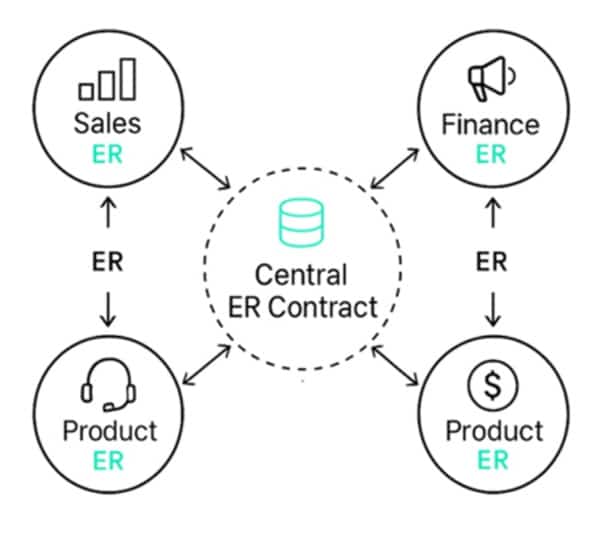
3. Data fabric or mesh (distributed entity resolution)
For marketing, local government, or HR use cases, departments may need to maintain autonomy while contributing to a central, trusted entity store. Each department may resolve prospect data locally, ERP systems handle supplier data, and both feed into a unified enterprise view. This balances local agility with global consistency.
Dhillon contrasted this with legacy master data management (MDM) platforms. “MDM isn’t going away,” he said, “but on its own, it can’t keep pace with GenAI’s real time demands.”
Trust By Design
When the discussion turned to compliance like GDPR, Dhillon underscored a key Senzing principle: privacy by design. “Our SDK runs behind your firewall,” he explained. “Your data never leaves your environment. You stay compliant and in control.”
He also noted that effective entity resolution often extends beyond a single dataset. Organizations are combining internal data with curated external signals such as sanctions lists, credit data, adverse media feeds, or other third-party data to achieve richer identity context and more accurate decisioning. Partnerships and open integrations amplify the value of entity resolution, especially in financial services, public safety, and digital-platform intelligence.
Building Trusted AI From the Ground Up
Dhillon closed with a reminder that technology alone will not guarantee success. “When you think about any AI initiative,” he said, “remember: it’s about people, process, data, and technology – it’s never just one.”
The message was clear: trust starts at the entity level. By embedding real time entity resolution into GenAI architectures, organizations can strengthen governance, accelerate insight, and scale innovation responsibly.
Watch the full Big Data London session, Trusted AI Starts Here, to learn how real time entity resolution can power AI you can trust.

Gurpinder Dhillon
Head of Data Partner Strategy & Ecosystem
Gurpinder Dhillon has over 20 years of experience in data management, AI enablement, and partner ecosystem development across global markets. Gurpinder is also a published author and frequent keynote speaker on AI ethics, master data strategy, and the evolving role of data in business innovation. He currently leads the strategic direction and execution of the Senzing data partner ecosystem.